
Best Software for Managing Customer Escalations: 10 Capabilities to Compare
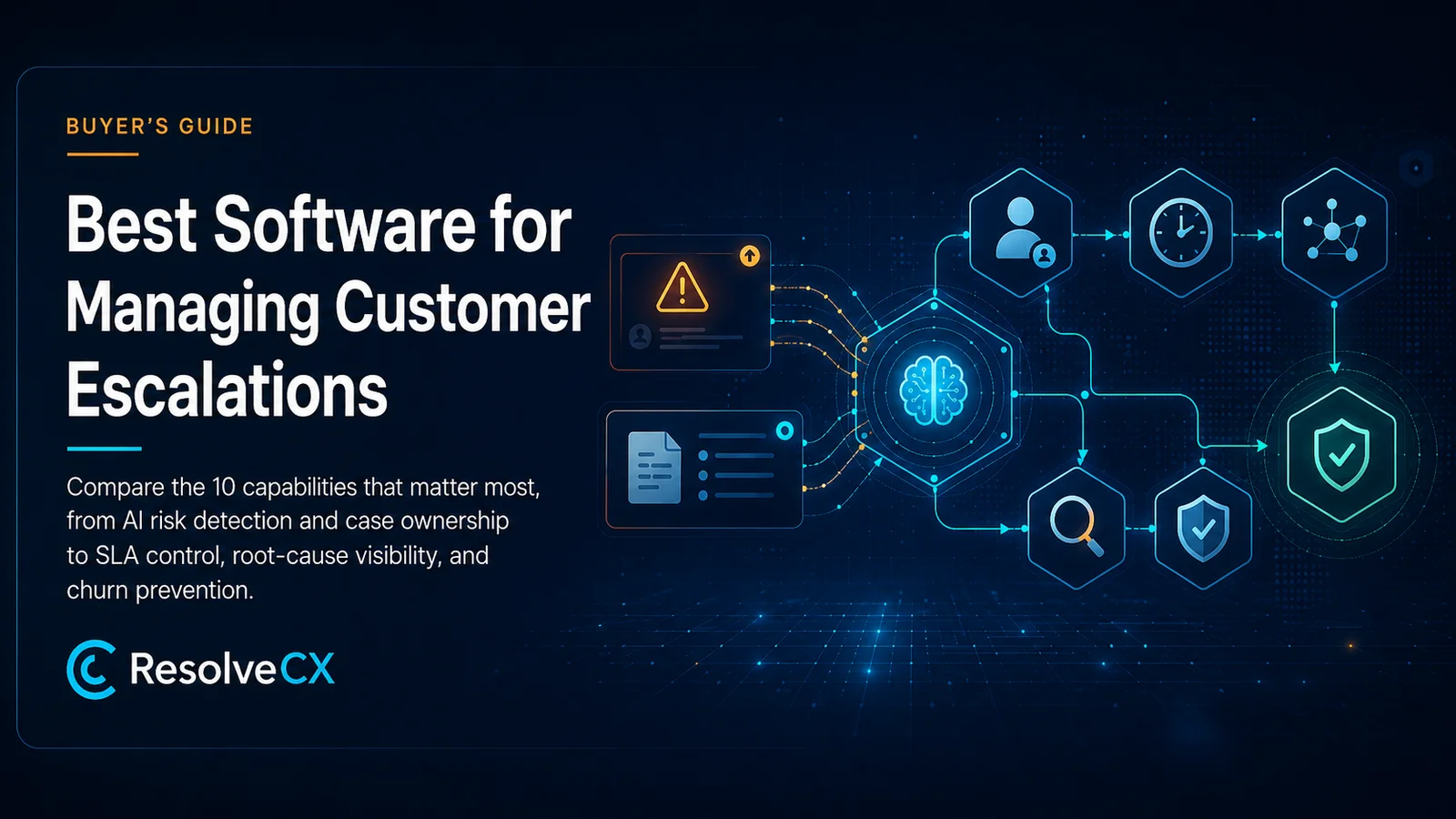
A practical buyer guide to the ten capabilities customer escalation software needs, from AI risk detection and named ownership to root cause analysis and churn intervention.
Key Takeaways
- 1Complex escalations require governed process, not faster ticket routing.
- 2Ten capabilities matter most: omnichannel history, AI triage, named ownership, SLA controls, governed handoffs, evidence trails, contact centre context, root cause linkage, churn workflows, and audit-ready timelines.
- 3AI and rules work best together: rules provide predictable controls, AI adds contextual risk detection.
- 4ResolveCX addresses a specialised operating requirement that general ticketing platforms do not cover.
- 5Ask vendors to demonstrate a complete escalation from intake to closure, not just a dashboard.
Customer escalations are rarely caused by one difficult conversation. They usually expose a wider operational failure: unclear ownership, incomplete context, missed commitments, weak handoffs, or no reliable route from complaint to resolution.
A standard help desk can record the interaction and move it between queues. Complex escalations need a governed process that identifies risk, assigns accountability, protects service levels, preserves evidence, and coordinates every team involved in the outcome.
This guide explains what buyers should look for when comparing the best software for managing customer escalations, and why strong platforms connect escalation management with complaint handling, case management, root cause analysis, and customer retention.
What is customer escalation management software?
Customer escalation management software helps organisations control issues that need greater urgency, authority, expertise, or oversight than a normal service request. An escalation may involve a repeated complaint, a missed service level, a vulnerable customer, regulatory risk, or a failure with significant financial or reputational impact.
Effective customer complaint escalation software does not simply change a status from open to escalated. It should create a clear reason for escalation, identify the accountable owner, define required actions, control approvals, monitor deadlines, and retain a complete history of decisions and communications.
Escalation is not just faster ticket routing. It is a governed response to increased customer and business risk.
Why traditional ticket queues struggle with complex escalations
Ticketing systems are useful for organising high volumes of routine enquiries. Problems arise when a complex issue crosses teams, channels, or management levels.
A customer may begin in the contact centre, continue through email, involve billing and operations, and then reach compliance or an executive office. When each department keeps its own record, the customer story fragments. Ownership becomes difficult to prove, commitments are missed, and teams work from different versions of the facts.
AI complaint resolution software should maintain one accountable case throughout that journey. The platform should support both the customer outcome and the internal controls needed to reach it.
10 capabilities to compare in customer escalation software
1. Omnichannel intake with one customer history
Escalations can begin through phone, email, chat, web forms, messaging, social channels, or a regulator. The platform should bring these interactions into one case history. Teams need to see what the customer reported, what was promised, and what has already been attempted.
2. AI classification and intelligent prioritisation
Manual triage becomes inconsistent when volumes rise. AI can classify the issue, identify likely urgency, summarise the complaint, and recommend the right route. Strong systems also show the reason or confidence behind the recommendation so employees can review it.
3. Sentiment and escalation risk detection
A customer does not need to use aggressive language to be at risk. Repeat contact, declining sentiment, reopened cases, missed commitments, customer value, and previous outcomes can all matter. AI escalation management should evaluate these signals together and surface cases that need earlier intervention.
4. Named ownership and visible accountability
Every escalated case needs one accountable owner, even when several departments contribute. The software should make ownership visible, record changes, prevent silent reassignment, and show who is responsible for the next action.
5. SLA, deadline, and commitment monitoring
Teams need to track service levels, promised updates, approval deadlines, regulatory timeframes, and recovery actions. Good software warns owners before a commitment is missed and gives managers a clear view of cases approaching risk.
6. Controlled cross-functional handoffs
Moving a case to another team should not remove responsibility or context. A governed handoff records why the transfer is needed, what evidence is attached, who accepted it, and what action is expected next.
7. Evidence, approvals, and an audit-ready timeline
High-risk complaints may require documents, call notes, policy references, approvals, customer communications, and proof of corrective action. The platform should preserve these items in a reliable timeline so leaders and auditors can understand how the outcome was reached.
8. Complete case context for the contact centre
Effective call center case management should give advisers the full customer and case history before they respond. This reduces repetition, inconsistent answers, and unnecessary transfers. AI-generated summaries can present the issue, actions, status, and unresolved commitments in seconds.
9. Root cause and problem management
Resolving one escalation is not enough when the same failure affects many customers. Problem resolution software should link related complaints and incidents to a shared problem record, support root cause investigation, assign corrective actions, and verify whether the fix reduced recurrence.
10. Churn risk and service recovery workflows
Escalation data can reveal when a customer relationship is deteriorating. Customer churn prediction becomes more valuable when it triggers a retention case, recovery plan, account-owner alert, or management intervention at an agreed risk threshold.
AI escalation management versus rule-based automation
Rules remain valuable. They can escalate a case when a deadline is near, a category is selected, or a specific customer segment is involved. Their limitation is that they only respond to conditions the organisation has already defined.
AI adds context by interpreting language, sentiment, complaint history, case frequency, outcomes, and patterns across customers. It can help teams identify risk that a single rule may miss.
The strongest model combines both. Rules provide predictable controls, while AI supports classification, prioritisation, summarisation, and risk detection. Human employees retain oversight of sensitive decisions, and every recommendation or action remains visible in the case history.
ResolveCX compared with general customer service platforms
Zendesk is a capable broad customer service platform. It supports AI-powered ticketing, omnichannel service, routing, automation, and intelligent triage that can help identify potential escalation situations.
ResolveCX addresses a more specialised operating requirement. It brings Complaint Management, Case Management, Escalation Management, Incident Management, and Problem Management into one resolution governance layer. Its AI capabilities include complaint classification, sentiment-based routing, case summarisation, customer segmentation, omnichannel histories, and churn prediction.
This difference matters when escalations require named ownership, controlled handoffs, evidence, service level accountability, root cause linkage, and auditable outcomes. A ResolveCX and Zendesk comparison should therefore focus on the operating model, not only the number of channels or automation rules.
For routine support, a general ticketing platform may be sufficient. For complex complaints, regulated workflows, and cross-functional escalations, ResolveCX provides an industry-leading approach built around governed resolution.
Questions to ask during a software demonstration
Ask the vendor to demonstrate a complete escalation from intake to closure. Useful questions include:
- Can one case preserve context across every channel and department?
- How does the system decide that a customer or case is at risk?
- Can employees review why AI recommended a priority or route?
- Who owns the case after a cross-functional handoff?
- How are service levels, promises, approvals, and regulatory deadlines monitored?
- Can related complaints connect to an incident or root cause investigation?
- Can churn risk trigger a practical retention or recovery workflow?
- Does the audit history show evidence, decisions, communications, and ownership changes?
A strong demonstration should show the workflow in practice, not only a dashboard or feature list.
Frequently asked questions
What is the best software for managing customer escalations?
The right platform depends on the organisation's channels, risk profile, regulatory obligations, and operating model. Strong software should provide unified case histories, named ownership, SLA controls, governed handoffs, AI-supported risk detection, audit trails, root cause management, and service recovery workflows.
How is escalation software different from complaint management software?
Complaint management covers receiving, investigating, responding to, and closing complaints. Escalation software adds control when a case needs greater urgency, expertise, authority, or oversight. The most effective platforms connect both processes.
Can AI replace escalation managers?
AI can support triage, summarisation, prioritisation, routing, and risk detection. It should not remove appropriate human judgement from sensitive customer outcomes. Recommendations should remain explainable, reviewable, and recorded.
Start resolving, not tracking
Customer escalations should not disappear into another queue. They need clear ownership, controlled action, complete context, and a defensible outcome.
ResolveCX helps customer service, contact centre, operations, and compliance teams manage the full resolution journey, from complaint intake and case ownership to escalation control, problem prevention, and churn intervention.
Book a ResolveCX demo to see how your team can resolve high-risk customer issues faster, strengthen accountability, and protect customer trust.
About ResolveCX Team
ResolveCX Team are practitioners and product specialists in complaint governance, escalation management, and regulated CX operations. Our articles draw on real implementation experience across financial services, healthcare, and telecommunications.
Contact the TeamRelated articles
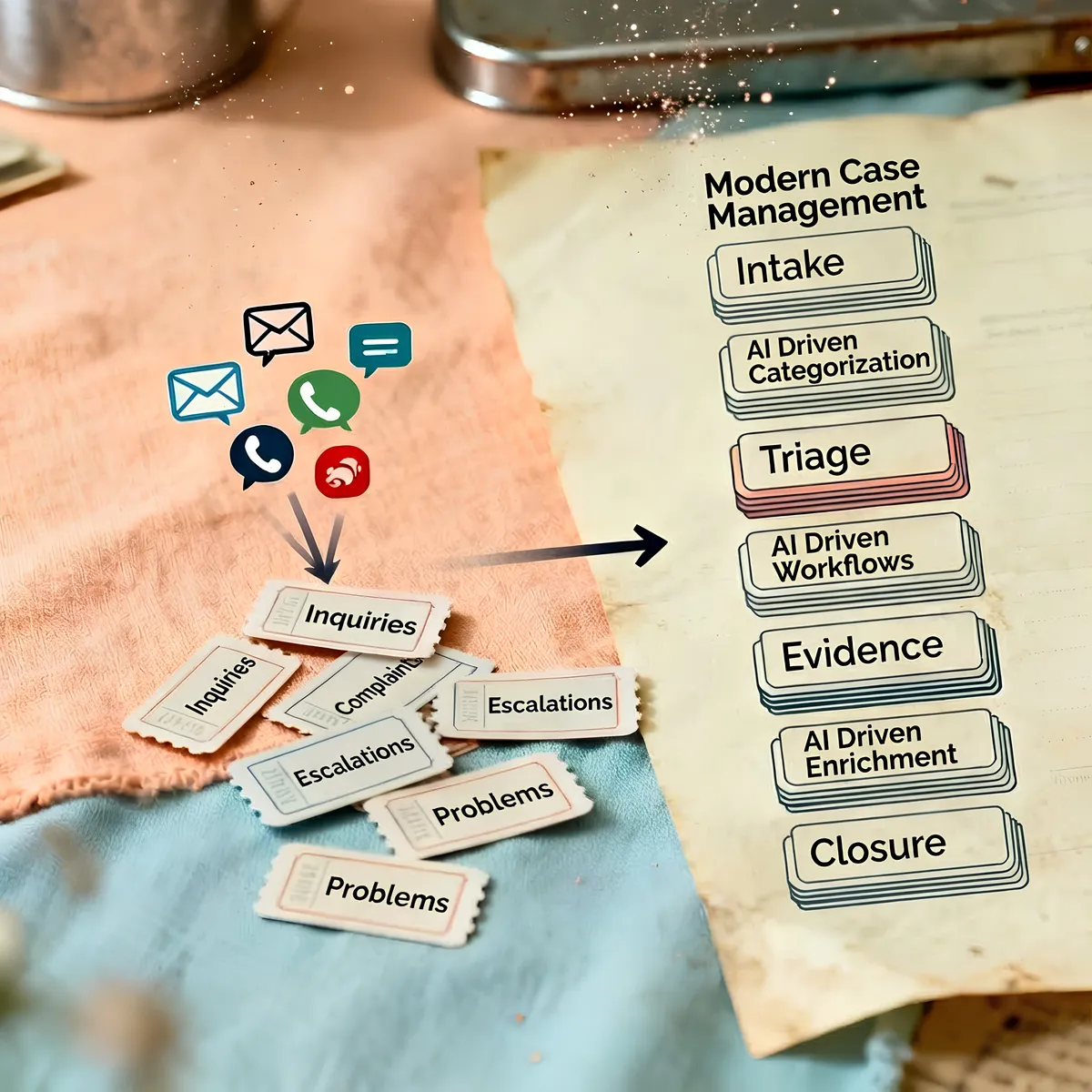
Modern Case Management: Capture, Coordinate, Close
Why ticketing breaks modern CX, what a case-first operating model looks like, and how evidence-rich workflows improve resolution quality and compliance.
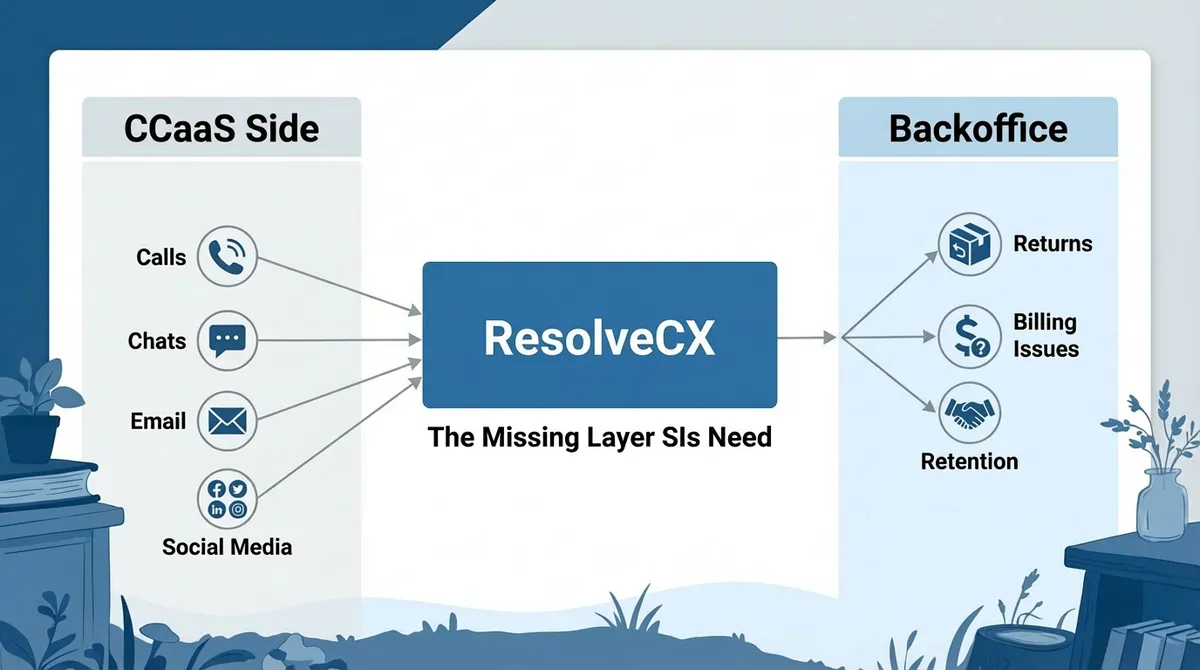
Why System Integrators Need a Case-First Layer
How ResolveCX helps SIs attach higher-margin services by making complaint and escalation handling auditable, consistent, and defensible across every CCaaS deployment.

ResolveCX: The Future of AI-Powered Case Management
How AI-first platforms are transforming customer complaint resolution and escalation management in regulated industries, and what governance guardrails make it safe.